Mastering the Aesthetic: The Power of Spider Web Corner Icons in Black and White Design
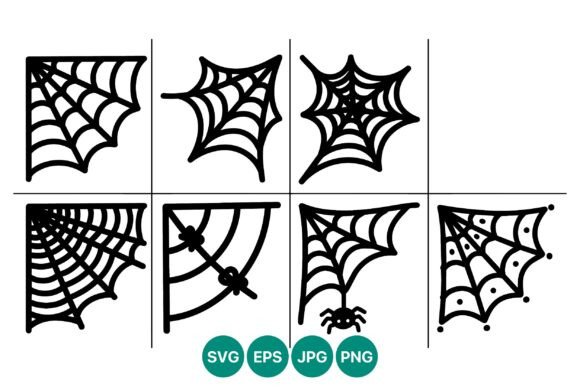
In the vast landscape of digital design, few motifs are as instantly recognizable or versatile as the spider web. Whether evoking a sense of mystery for Halloween, adding a touch of gothic elegance to a wedding invitation, or serving as a structural element in modern UI design, these intricate patterns hold a unique place in visual communication. Recently, a specific set of eight black spider web icons has gained traction among designers for its simplicity and versatility. This collection, featuring varying shapes, a hanging spider, and decorative dots, represents more than just a graphic asset; it is a toolkit for creating high-contrast, scalable, and professional artwork.
This article explores the significance of these simple line art style icons, how they function within modern workflows, and why the availability of multiple file formats like SVG, PNG, JPG, and EPS makes them indispensable for both beginners and seasoned professionals.
The Anatomy of Minimalist Web Iconography
To understand the value of this specific icon set, one must first appreciate the philosophy behind minimalist line art. Unlike complex illustrations filled with gradients and shadows, line art relies on clean strokes to define form. In the case of the spider web corner icons, the design strips away unnecessary detail, focusing on the geometric precision of the web's radial symmetry.
The set includes eight distinct variations. Some feature tight, concentric circles typical of an orb-weaver's construction, while others offer looser, more organic curves. One standout variation includes a hanging spider, adding a focal point that draws the eye immediately. Another features decorative dots, which break up the linear flow and add texture without clutter. These elements work together to create a cohesive library that can be mixed and matched to suit various design needs.
Why Black and White Matters
The decision to render these icons in stark black and white is a strategic choice rooted in design theory. High-contrast imagery ensures legibility across different backgrounds and mediums. When you remove color, you force the viewer to focus on the shape and structure. This makes the icons incredibly adaptable:
- Versatility: They can be placed over dark backgrounds (by inverting colors) or light ones without clashing.
- Print Efficiency: Black ink is standard in most printing processes, making these icons cost-effective for mass production.
- Timelessness: Color trends change, but the classic contrast of black and white remains perpetually stylish.
The Technical Advantage: Understanding File Formats
A critical aspect of this icon set is the comprehensive delivery format. The download package arrives as a ZIP folder containing files in SVG, PNG, JPG, and EPS formats. For many users, understanding the difference between these formats is the key to unlocking their full potential.
Vector Magic: SVG and EPS
The crown jewels of this collection are the SVG (Scalable Vector Graphics) and EPS (Encapsulated PostScript) files. These are vector-based formats, meaning the image is defined by mathematical equations rather than a grid of pixels. This distinction is vital for scalability.
When you zoom in on a raster image (like a standard photo), it eventually becomes pixelated and blurry. However, because these spider web icons are 100% vector, they remain crisp and sharp at any size. You could shrink them down to a tiny favicon for a website or blow them up to cover a billboard, and the lines would remain perfectly smooth. This is particularly important for print designers who need to ensure that the fine details of the web strands do not disappear when printed on large paper stocks.
Raster Utility: PNG and JPG
While vectors are superior for editing and scaling, raster formats like PNG and JPG serve immediate practical purposes. PNG files support transparency, allowing the black spider web to sit cleanly over colorful backgrounds without an unwanted white box around it. JPG files are ideal for quick sharing on social media or embedding in documents where file size is a concern. Having all four formats included means the user does not need specialized software to convert files before using them.
Practical Applications in Modern Life and Business
These icons are not merely decorative; they solve real-world design problems. Their "corner" orientation suggests a framing function, making them perfect for borders, page dividers, and layout accents. Let's explore how they fit into various sectors.
Creative Industries and Branding
For businesses in the creative sector—such as tattoo studios, horror-themed cafes, or boutique clothing brands—the spider web icon serves as a powerful branding tool. The hanging spider variant, in particular, adds a narrative element. It suggests movement and life, transforming a static border into a scene. A brand might use the web with decorative dots as a watermark on packaging, subtly reinforcing a theme of intricacy and nature without overwhelming the customer.
Education and Publishing
In educational materials, especially those related to biology, ecology, or literature, clear iconography aids comprehension. Teachers can use these simple line art webs to illustrate concepts about arachnids or seasonal changes in nature studies. Because the lines are clean, they reproduce well in textbooks and worksheets, ensuring that students can see the structure clearly regardless of the paper quality.
Digital User Interfaces
In the realm of technology, user interface (UI) design demands clarity. While spider webs are niche, the principles of the icon set apply broadly. The high-contrast nature of the graphics makes them suitable for loading screens, error messages, or thematic overlays in gaming applications. The SVG format allows developers to integrate these icons directly into code, ensuring they load quickly and look perfect on retina displays.
Common Misunderstandings About Icon Sets
Despite their utility, there are common misconceptions regarding stock icon sets that can hinder their effective use.
- "They are too generic." Many assume that free or low-cost icons lack character. However, the inclusion of unique variations, such as the specific arrangement of decorative dots or the pose of the hanging spider, proves that even simple sets can offer distinct personality.
- "I need advanced skills to use them." A frequent barrier to entry is the fear that vector files require expensive software like Adobe Illustrator. In reality, many modern tools, including free alternatives like Inkscape or even web-based editors, can manipulate SVG and EPS files easily.
- "Black and white limits creativity." On the contrary, monochrome assets often spark more creativity. Designers are forced to rely on composition, spacing, and typography rather than hiding behind bold color palettes. Furthermore, these black icons can easily be recolored to match any brand guideline once imported into a design program.
Building a Broader Design Vocabulary
Integrating a set of spider web corner icons into your workflow is about more than just adding a spooky element to a project. It is about understanding the power of modular design. By having a set of eight variations, a designer can create rhythm and repetition. Imagine a brochure where each page uses a different web variant in the corners, guiding the reader through the document with subtle visual cues.
Furthermore, the shift towards line art in modern aesthetics reflects a broader trend toward digital minimalism. As screens become smaller and attention spans shorter, designs that communicate quickly and clearly win out. The spider web, with its inherent complexity reduced to simple lines, embodies this balance perfectly. It offers the intrigue of a complex pattern with the efficiency of a simple symbol.
Conclusion
The set of eight black spider web icons, complete with a hanging spider and decorative accents, represents a quintessential example of effective digital asset creation. By offering high-contrast visuals in multiple formats—including the scalable power of SVG and EPS—it bridges the gap between technical requirements and artistic expression. Whether used to frame a Halloween party invitation, accentuate a biological diagram, or add a touch of gothic flair to a business card, these icons demonstrate that sometimes, the simplest lines make the strongest impression. For anyone looking to elevate their design projects with reliable, sharp, and versatile graphics, understanding and utilizing such resources is a fundamental step toward professional excellence.